
Summary
Surfing in Bali puts specific stress on shoulders, knees, ankles, and spine. BPC-157, TB-500, and KPV are the most researched peptides for surf-related injuries — this guide covers what the science shows and what Bali surfers are using.
Why Surfing Is Hard on the Body
Bali's waves — from the long walls of Canggu to the heavy barrels of Uluwatu — attract surfers of every level. They also produce a predictable set of injuries.
The mechanics of surfing create specific and repeated stress patterns:
Paddle shoulder: The anterior deltoid, rotator cuff (particularly supraspinatus and infraspinatus), and bicep tendons bear enormous cumulative load from hours of paddling. SLAP tears, rotator cuff tendinopathy, and AC joint irritation are the most common chronic injuries in regular surfers.
Knee stress: The pop-up — from prone to standing in a fraction of a second — places acute load on the patellar tendon and medial collateral ligament. Beginners pop up awkwardly; experienced surfers pop up hundreds of times per session. Either way, the knee accumulates stress.
Ankle and foot: Wiping out in reef breaks, hitting shallow sand, and sustained flexion during tube riding create ankle ligament stress and occasional fractures.
Lower back: The sustained hyperextension required during paddling loads the lumbar spine. After months of daily surfing, disc and facet joint irritation is common.
Skin and reef contact: Reef rash creates open wounds prone to tropical infection — a different category of concern but one that BPC-157's gut mucosal healing research has some application to, given its anti-inflammatory properties in tissue.
Bali surfers face one additional challenge: they surf every day, in warm tropical conditions, often without the physiotherapy infrastructure they would have access to at home. Recovery has to be faster than the injury rate, or performance degrades progressively over a season.
The Research Behind Recovery Peptides
BPC-157 — The Repair Compound
Body Protection Compound-157 (BPC-157) is a synthetic pentadecapeptide derived from a naturally occurring protein in human gastric juice. The mechanism most relevant to surf injuries involves:
Tendon repair: BPC-157 has been shown in multiple animal studies to promote the proliferation of tendon fibroblasts and the formation of new blood vessels (angiogenesis) at injury sites. The formation of new vasculature is critical for tendon healing — tendons are inherently poorly vascularised, which is why tendon injuries heal slowly.
Growth factor upregulation: Research shows BPC-157 upregulates growth hormone receptor expression and increases local levels of VEGF (vascular endothelial growth factor), both of which support tissue repair.
Anti-inflammatory action: BPC-157 modulates the inflammatory cascade — reducing excess inflammation while maintaining the healing signals needed for repair. Chronic low-grade inflammation is one of the primary drivers of tendinopathy.
For paddle shoulder, the BPC-157 mechanism is directly relevant: the compound targets the biological bottleneck in tendon recovery — inadequate blood supply and fibroblast activity.
TB-500 — The Systemic Healer
Thymosin Beta-4 (TB-500 is the synthetic fragment most commonly used in research) works via a different but complementary mechanism. Its primary actions:
Actin regulation: TB-500 binds to actin monomers, regulating cell motility and enabling the migration of repair cells to injury sites. This systemic cell-mobilisation effect is distinct from BPC-157's more localised mechanism.
Blood vessel formation: TB-500 promotes new blood vessel growth — particularly relevant for tissue that has been chronically deprived of adequate circulation.
Muscle tissue repair: Animal research shows TB-500 accelerating healing of cardiac and skeletal muscle, with implications for the muscle belly damage that can accompany tendon injuries.
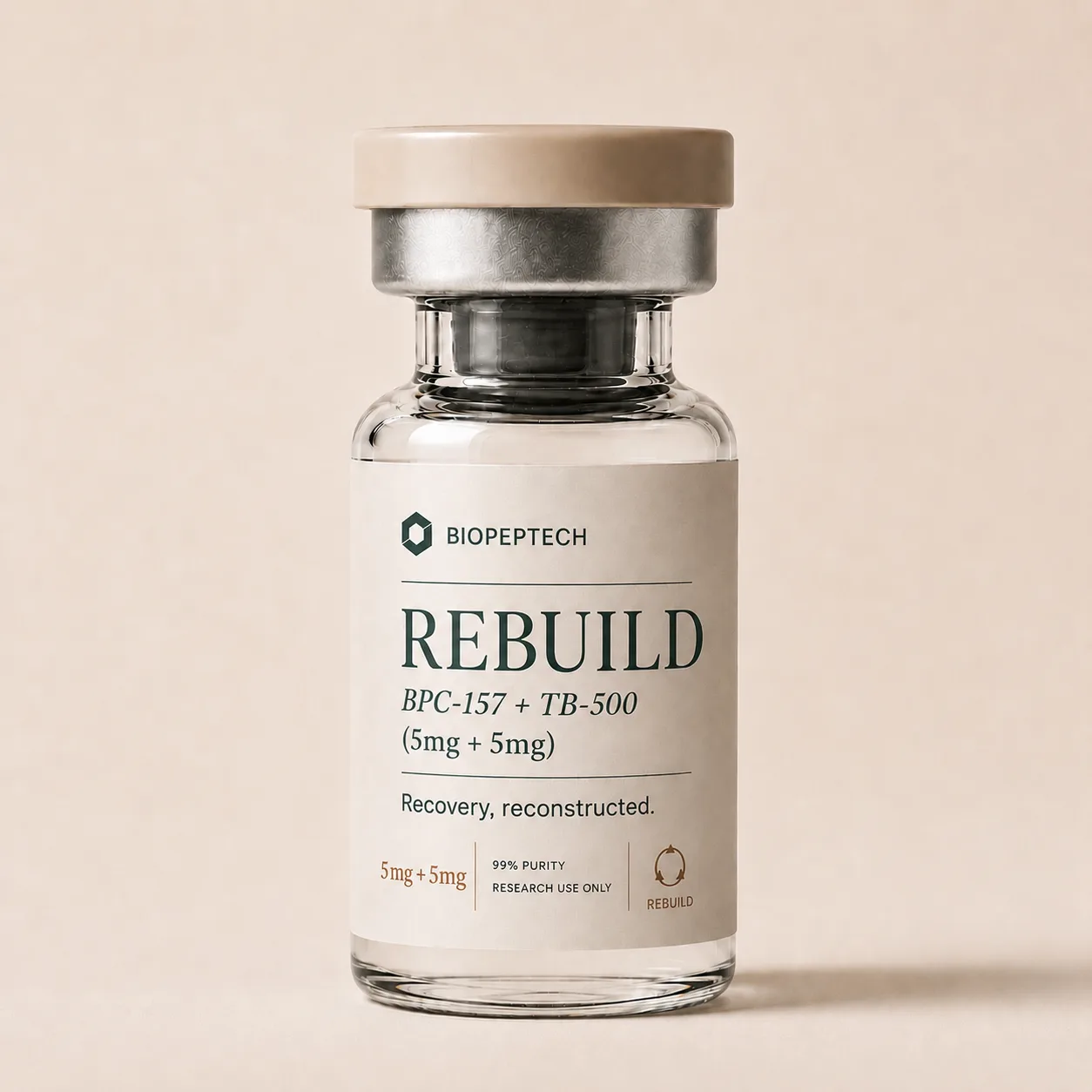
The practical significance: BPC-157 drives repair at the specific injury site; TB-500 mobilises the body's repair machinery systemically. Used together (as in the REBUILD stack), they address the same injury from different biological angles simultaneously.
KPV — The Anti-Inflammatory
KPV is a tripeptide (Lys-Pro-Val) — the C-terminal fragment of alpha-MSH. Its primary researched property is potent anti-inflammatory activity, particularly relevant for:
- Acute tissue inflammation immediately after injury
- Chronic inflammatory tendinopathy
- Skin and mucosal wound healing (reef rash)
KPV does not drive structural tissue repair the way BPC-157 does, but it can reduce the inflammatory burden that slows it.
Matching Peptides to Surf Injuries
| Injury Type | Recommended Compounds | Notes |
|---|---|---|
| Rotator cuff / paddle shoulder | BPC-157 + TB-500 (REBUILD stack) | Most well-supported combination for tendon repair |
| Knee tendinopathy | BPC-157 + TB-500 | Patellar and quadriceps tendon research in animal models |
| Ankle ligament | BPC-157 | Ligament research more limited than tendon; TB-500 adds systemic support |
| Lower back (disc irritation) | BPC-157 | Gut and disc tissue research; also has spinal cord injury models |
| Reef rash / skin wounds | KPV (topical or subcutaneous) | Anti-inflammatory; skin and mucosal research |
| Acute swelling and pain | KPV first, then REBUILD | Address inflammation before driving structural repair |
What Bali Surfers Are Using
The Bali surf community — particularly in Canggu and Uluwatu, where daily multi-hour sessions are the norm — has developed a working knowledge of recovery peptides that often exceeds what you'll find in formal supplement guides.
The most common practical approaches:
Post-injury protocol: Begin BPC-157 and TB-500 immediately after a significant injury, typically at 5mg each per vial, administered subcutaneously. Most researchers use this for 4–8 weeks depending on severity, with a protocol break before reassessment.
Maintenance protocol: Some surfers use a lower-dose, intermittent protocol during heavy surf seasons — not targeting a specific injury but maintaining connective tissue health during high-load periods.
The SOOTHE addition: KPV is added by some researchers during the acute inflammatory phase of a new injury, then discontinued once the acute phase resolves and structural repair becomes the priority.
Sourcing in Bali
BioPepTech lists BPC-157, TB-500, KPV, and the REBUILD stack (BPC-157 + TB-500 pre-combined). Confirm current availability and delivery timing for the selected item and destination.
Product pages show exact product, dosage, and lot records where available. Confirm which record matches the selected item; cold-pack delivery supports temperature control in transit.
For surfers who don't want to manage reconstitution — adding bacteriostatic water, drawing doses with a syringe — the REBUILD stack is available in a pre-filled vial format that reduces the preparation step to a single draw.
Safety & Regulatory Note
Research peptides are for laboratory use only. BPC-157, TB-500, and KPV are not approved medical treatments. The research described in this article is primarily from animal models. This guide is for educational purposes and does not constitute medical advice. For acute or serious injuries, consult a qualified sports medicine physician.
References
- 1.Sikiric P, Seiwerth S, Rucman R, et al. (2018). Brain-gut axis and pentadecapeptide BPC 157: Theoretical and practical implications. Current Neuropharmacology, 16(7), 1006–1025. https://doi.org/10.2174/1570159X15666170619144112
- 2.Chang CH, Tsai WC, Lin MS, Hsu HC, Pang JH. (2011). The promoting effect of pentadecapeptide BPC 157 on tendon healing involves tendon outgrowth, cell survival, and cell migration. Journal of Applied Physiology, 110(3), 774–780. https://doi.org/10.1152/japplphysiol.00945.2010
- 3.Goldstein AL, Hannappel E, Kleinman HK. (2005). Thymosin beta4: Actin-sequestering protein moonlights to repair injured tissues. Trends in Molecular Medicine, 11(9), 421–429. https://doi.org/10.1016/j.molmed.2005.07.004
- 4.Ruff RL, McKerracher L, Selzer ME. (2008). Repair and neurorehabilitation strategies for spinal cord injury. Annals of the New York Academy of Sciences, 1142, 1–20. https://doi.org/10.1196/annals.1444.003
- 5.Huang T, Liu R, Fu X, et al. (2018). Aging reduces an ERRalpha-directed mitochondrial glutaminase expression suppressing glutamine anaplerosis and osteogenic differentiation of mesenchymal stem cells. Stem Cells, 35(2), 411–424.