
Summary
What Indonesian law actually says about research peptides, prescription drugs, and BPOM registration — with primary sources.
Legal disclaimer
This article is for general informational purposes only and does not constitute legal advice. Peptide regulation in Indonesia is complex and enforcement can vary. If you need legal certainty about a specific situation, consult a licensed Indonesian lawyer.
The short answer is about authorization, not just scheduling
Indonesian law does not turn only on whether a compound is “scheduled.” The practical legal question is whether the product being imported, offered, or distributed has the required BPOM marketing authorization, known as an izin edar, and whether the transaction complies with the rules that apply to that product. A product without the required authorization can be an unregistered pharmaceutical product—obat tanpa izin edar—regardless of whether the underlying substance appears on a controlled-substance schedule.
That distinction matters in Bali because online listings often describe products as “research peptides,” “not for human use,” or “available same day.” Those words do not settle the legal status of the product. The product form, claims, route of administration, intended recipient, import route, seller, and distribution channel all matter. This page is a compliance explainer, not a recommendation to buy, sell, import, or use any peptide.
What BPOM authorization means
BPOM, the Indonesian Food and Drug Authority, regulates medicines and other products that fall within its authority. An izin edar is a marketing authorization showing that a product has gone through the applicable BPOM registration process and may be distributed under the approved identity, composition, packaging, indications, and conditions.
An izin edar is not interchangeable with:
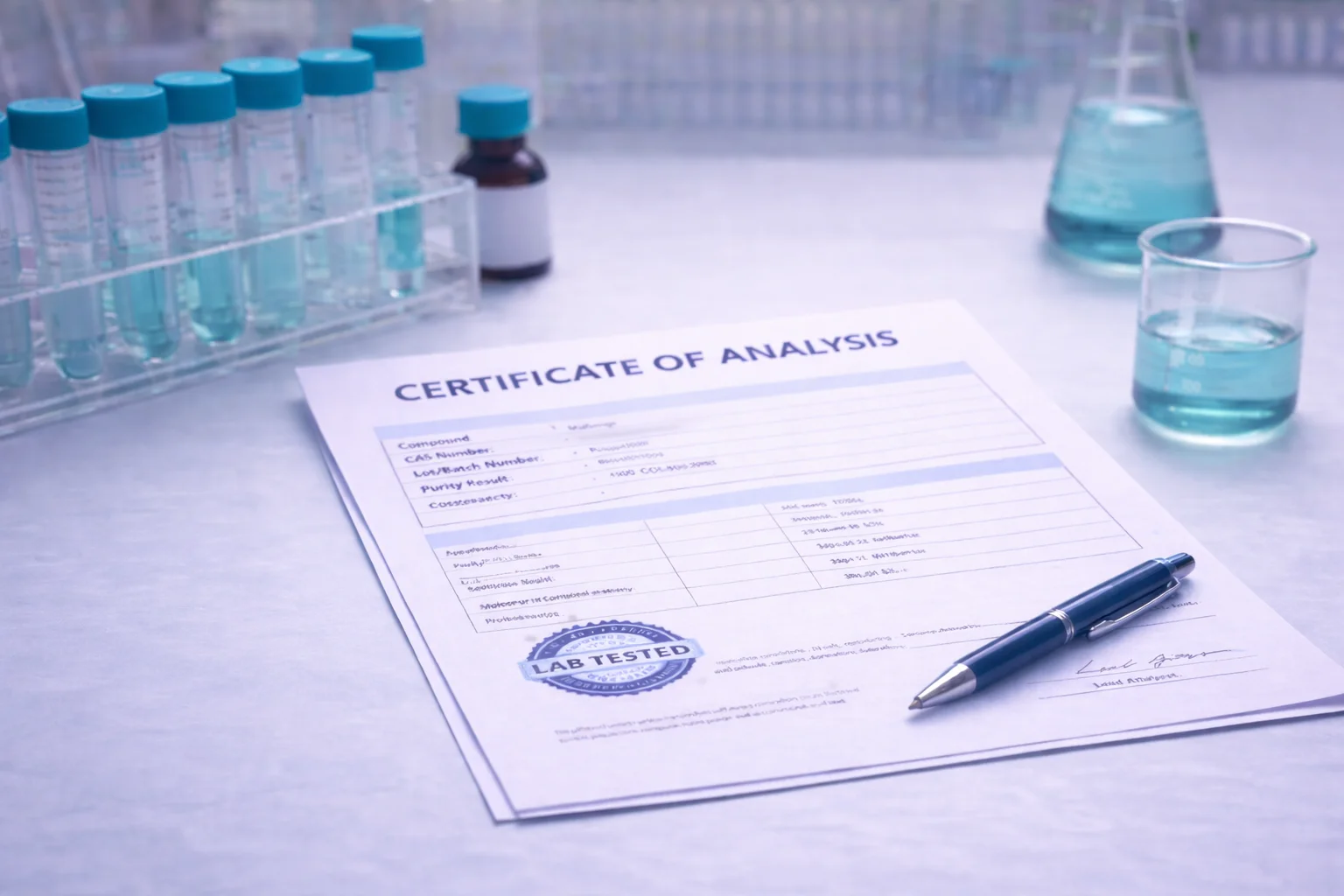
- A seller's Certificate of Analysis, which reports testing on a sample or batch.
- A private laboratory report with no BPOM authorization.
- An import invoice, customs document, or shipping receipt.
- A statement that the substance is not a narcotic or psychotropic.
- A “research use only” label.
Those documents or statements may answer different questions, but none automatically replaces marketing authorization.
PerBPOM No. 28 Tahun 2023 is officially titled a regulation amending PerBPOM No. 27 Tahun 2022 on the control of the entry of drugs and food into Indonesian territory. In other words, it is an import-control instrument, not a general list of which peptide molecules are scheduled. It sits within the broader BPOM compliance framework for regulated products entering Indonesia. For a product that requires authorization, the absence of an applicable izin edar is not cured simply by changing the wording on the label or by describing the shipment as research material.
The practical conclusion is straightforward: a product intended for distribution in Indonesia must meet the applicable BPOM requirements. If it is a pharmaceutical preparation that has no required marketing authorization, it should not be treated as lawfully marketable to Indonesian consumers. The phrase obat tanpa izin edar is used for an unregistered drug or pharmaceutical product, but the exact legal classification of a particular item depends on the facts and the regulator's assessment.
Injectable prescription-type products and Daftar G
Many injectable prescription-type medicines are treated as obat keras, often referred to in public discussions as Daftar G medicines. This is a prescription-only category. In ordinary legal operation, such medicines are dispensed through licensed pharmaceutical channels, such as pharmacies, under the supervision of the relevant health professionals and with a prescription where required.
That is very different from a product being sold directly to consumers through an informal website, social-media account, messaging app, or delivery service. A listing that uses medical language, offers an injectable vial, and invites direct payment creates a different compliance question from a licensed pharmacy dispensing an authorised medicine under a prescription. Calling the item a peptide does not remove the obligations attached to its dosage form or pharmaceutical character.
This also explains why “not scheduled” is an incomplete answer. Scheduling rules are one part of controlled-substance regulation. BPOM registration, product authorization, prescription classification, import controls, advertising rules, and distribution requirements are separate legal questions. A compound may not be a narcotic and still be unlawful to distribute as an unregistered pharmaceutical product.
What Pasal 435 says
UU No. 17 Tahun 2023 tentang Kesehatan, the Health Law, contains criminal provisions for pharmaceutical products that fail required standards or requirements. Pasal 435 provides that the conduct covered by the article can be punished by a maximum of 12 years' imprisonment or a maximum fine of Rp5,000,000,000—five billion rupiah.
That wording must be read carefully. “Up to” is a statutory maximum, not a guaranteed outcome. It does not mean every person connected with every unregistered product automatically receives that sentence or fine. Enforcement depends on the facts, the evidence, the product's legal status, the alleged conduct, the charge selected, the prosecutor's case, and the court's interpretation. Other provisions may also be relevant depending on importation, advertising, consumer harm, professional involvement, or the specific product.
The safe compliance lesson is not to calculate how close a transaction might be to a penalty threshold. It is to recognise that producing or distributing pharmaceutical preparations without meeting applicable standards and authorization requirements can carry serious consequences. Anyone seeking certainty about a specific import, sale, clinic arrangement, or research activity should obtain advice from a licensed Indonesian lawyer.
The registration picture in 2026
Registration is product-specific. It is not enough to say that an active ingredient is “legal” in the abstract. The name, manufacturer, strength, dosage form, packaging, indications, and registration number all matter.
As of the date of this draft:
- Semaglutide: BPOM's public assessment material identifies an authorised semaglutide product, WEGOVY 2,27 MG, with a BPOM registration number and approved product information. Other semaglutide products must still be checked individually.
- Tirzepatide: BPOM announced in June 2026 that it had issued marketing authorization for a tirzepatide medicine for type 2 diabetes. The authorization applies to the approved product and indications, not automatically to every tirzepatide vial or online listing.
- BPC-157: No Indonesian BPOM marketing authorization was identified in the public product records reviewed for this draft. That status should be rechecked against the current BPOM database before publication.
- Retatrutide: No Indonesian BPOM marketing authorization was identified in the public product records reviewed for this draft. Its research status does not create an Indonesian izin edar.
The right way to verify a product is to search the official Cek Produk BPOM database and match the result to the product's exact name, manufacturer, dosage form, and registration number. A search result for one authorised medicine does not legalize an unregistered version, a compounded product, a research vial, or a different supplier's packaging.
Why “research use only” does not settle the question
“Research use only” is commonly used by sellers as a positioning workaround. It may indicate that the seller does not want to describe a product as a medicine, but a label cannot rewrite the underlying facts. It does not automatically create a legal exemption, grant BPOM authorization, or make direct-to-consumer distribution lawful.
Authorities and courts can look at the substance of a transaction rather than a single phrase. Relevant facts may include how the product is described, whether health or treatment outcomes are advertised, whether the item is injectable, who buys it, how it is imported, how payment is taken, and whether the seller is operating through a licensed channel. A private CoA can provide analytical information, but it does not answer all of those legal questions.
For that reason, this draft does not provide instructions for avoiding Indonesian controls. It is safer to treat an unregistered pharmaceutical product as a compliance risk and stop for legal advice than to assume a disclaimer has solved the problem.
A practical compliance checklist
Before relying on any claim about legality in Bali or Indonesia:
- Identify the exact product, manufacturer, dosage form, strength, and intended indication.
- Search the official BPOM database for the matching product and registration number.
- Distinguish an izin edar from a private CoA or a customs document.
- Ask whether the seller is licensed to distribute the product through the channel being offered.
- Treat “not scheduled” and “research use only” as incomplete answers, not legal conclusions.
- Check whether the proposed activity involves importation, advertising, direct consumer sale, a clinic, a pharmacy, or professional services.
- Do not assume that authorization for semaglutide or tirzepatide applies to an unregistered research version or a different product.
- Obtain advice from a licensed Indonesian lawyer if the decision involves importing, selling, prescribing, dispensing, or operating a research program.
The honest answer to “are peptides legal in Bali?” is therefore not a universal yes or no. Some authorised peptide medicines can be legally available through licensed Indonesian channels for approved uses. A research label does not establish the same status. For any specific product, the decisive questions are authorization, product identity, distribution channel, intended use, and the facts of the transaction—not the word “peptide” and not whether someone has called the product unscheduled.
Safety & Regulatory Note
This draft is for internal legal review and general informational purposes only. It is not legal advice.
References
- 1.Badan Pengawas Obat dan Makanan Republik Indonesia. (2023). Peraturan BPOM Nomor 28 Tahun 2023 tentang Perubahan atas Peraturan BPOM Nomor 27 Tahun 2022 tentang Pengawasan Pemasukan Obat dan Makanan ke dalam Wilayah Indonesia. https://jdih.pom.go.id/view/slide/1535/28/2023/312351bff07989769097660a56395065
- 2.Kementerian Kesehatan Republik Indonesia. (2023). Undang-Undang Nomor 17 Tahun 2023 tentang Kesehatan. https://farmalkes.kemkes.go.id/en/unduh/uu-17-2023/
- 3.Badan Pengawas Obat dan Makanan Republik Indonesia. (2026). Persetujuan Tirzepatide sebagai Terapi DM Tipe 2. https://registrasiobat.pom.go.id/berita-dan-publikasi/berita/persetujuan-tirzepatide-sebagai-terapi-dm-tipe-2
- 4.Badan Pengawas Obat dan Makanan Republik Indonesia. (2024). Public Assessment Report: WEGOVY 2,27 MG (semaglutide). https://registrasiobat.pom.go.id/daftar-produk/assesment-report/DKI2464605443C1
- 5.Badan Pengawas Obat dan Makanan Republik Indonesia. (2026). Cek Produk BPOM — database produk teregistrasi. https://cekbpom.pom.go.id/all-produk
