
Summary
A practical guide to understanding a peptide Certificate of Analysis (CoA), what each section means, how purity percentage is measured, and why it matters for research integrity.
BioPepTech products are supplied strictly for research use only. They are not intended for human consumption and are not intended to diagnose, treat, cure, or prevent disease.
Quick Summary
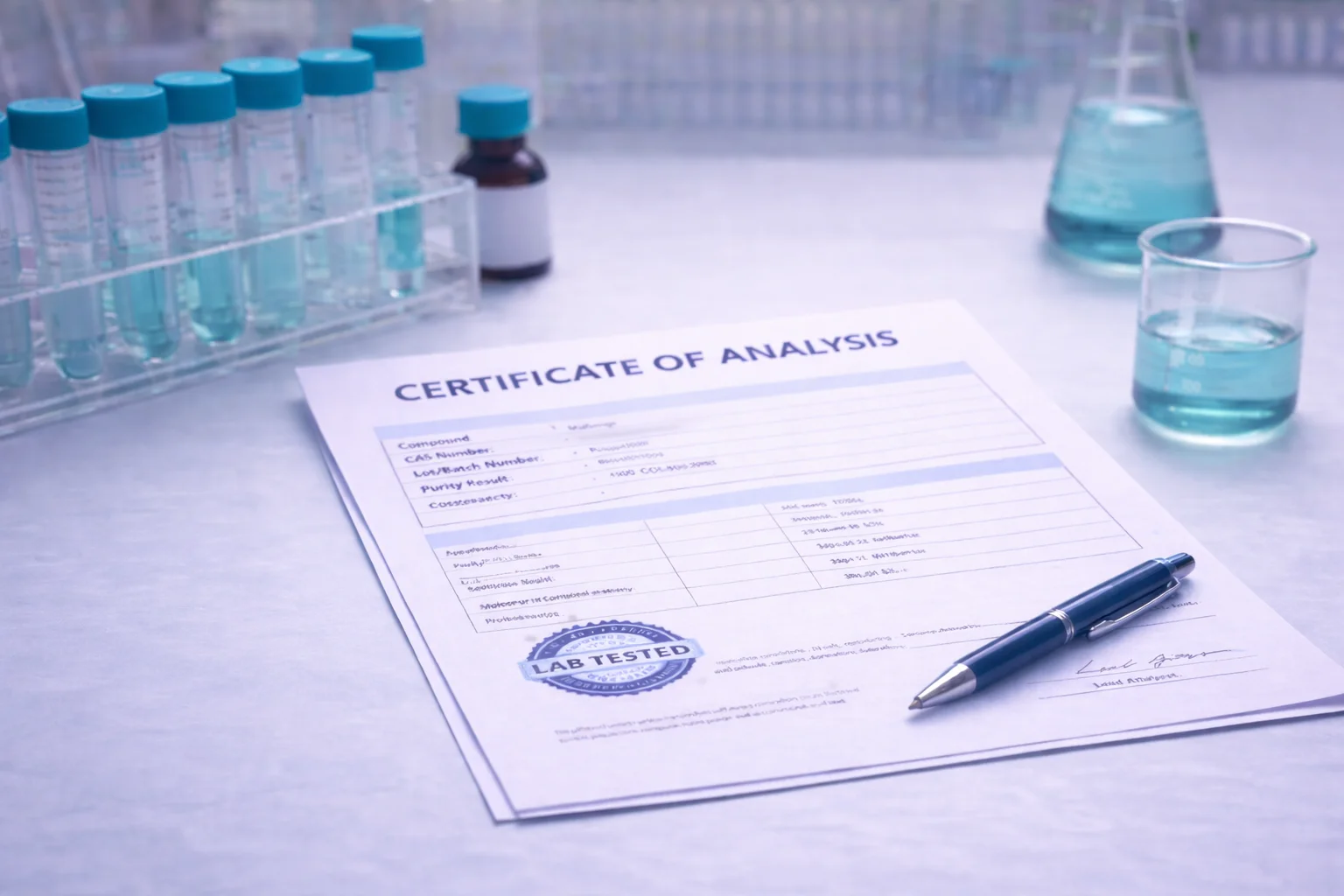
A Certificate of Analysis (CoA) is a document issued by an analytical laboratory that confirms the identity, purity, and quality of a compound. For research peptides, a valid CoA is the primary evidence that what is written on the vial label matches what is actually inside.
Knowing how to read a CoA means being able to distinguish between a supplier that has genuinely tested their product and one that has simply printed a number on a website. This guide explains every section of a standard peptide CoA, what the purity percentage actually measures, what other tests should accompany purity data, and what to look for when evaluating a document's legitimacy.
What Is a Certificate of Analysis?
A Certificate of Analysis is a formal quality document issued by an analytical laboratory after testing a specific batch of compound. It records the results of one or more analytical methods applied to that batch.
A CoA is always batch-specific. It applies to one production lot and one lot only. The lot number on the CoA must match the lot number printed on or attached to the physical vial.
A CoA from a different lot, a different date, or with no lot number at all provides no reliable information about the vial in your hands.
Who issues a CoA?
The most trustworthy CoAs are issued by independent third-party laboratories — organisations with no commercial interest in the outcome of the test. When a supplier tests their own products in-house without external verification, there is no way to independently confirm the result.
BioPepTech product pages show batch-specific analytical records when available. The laboratory and test types can vary by product and lot, so verify that the lot reference on each report matches the material being evaluated.
The Anatomy of a Peptide CoA
1. Laboratory name and accreditation
The document header should clearly identify the issuing laboratory. Look for accreditation credentials such as ISO/IEC 17025, which is the international standard for testing laboratories. Accreditation means the laboratory's methods, equipment, and personnel have been externally audited and verified.
A CoA with no laboratory name, no contact information, or no accreditation reference is not a reliable document.
2. Client and compound information
This section identifies:
- The supplier or client who submitted the sample
- The compound name
- The CAS number (if applicable)
- The lot or batch number
- The sample receipt date
The lot number is the critical link between the CoA and the physical vial. If these do not match, the CoA is irrelevant to the sample being tested.
3. Test date and report date
Both dates should be present. The test date confirms when the analysis was actually performed. The report date is when the document was issued.
Be cautious of CoAs with very old test dates. Peptide purity can change over time, particularly if storage conditions have not been maintained correctly. A batch tested two or three years ago and stored improperly may no longer match its original CoA results.
4. Analytical method
The CoA should state which method was used to determine purity. For peptides, the two most common methods are:
| Method | What it measures |
|---|---|
| HPLC (High-Performance Liquid Chromatography) | Separates components in a mixture; measures each peak's area as a percentage of the total |
| UPLC (Ultra-Performance Liquid Chromatography) | A faster, higher-resolution variant of HPLC; increasingly standard for peptide analysis |
Both HPLC and UPLC are chromatographic techniques that work by passing a dissolved sample through a column that separates its components by their chemical properties. The detector then measures how much of each component is present relative to the whole.
The method name and column details should appear on the CoA. A document that states only "purity tested" without naming the method cannot be independently evaluated.
5. Purity percentage
This is usually the number most prominently displayed — and the one most commonly misunderstood.
The purity percentage produced by HPLC or UPLC represents the chromatographic purity: the fraction of the detected signal that corresponds to the target peptide, expressed as a percentage of all detected signals.
A result of 99% purity means that 99% of what the detector detected was the target peptide. The remaining 1% includes other detectable compounds — which may be residual synthesis by-products, truncated sequences, or related impurities.
What purity does not measure:
- It does not confirm that the compound is the correct peptide (that requires mass spectrometry)
- It does not confirm the absence of undetectable contaminants such as endotoxins
- It does not account for compounds present below the detector's sensitivity threshold
This is why purity percentage alone is necessary but not sufficient for evaluating a research peptide.
6. Identified impurities
A high-quality CoA will not only give the purity percentage but also list the individual impurities detected above the reporting threshold, typically expressed as a percentage of total area. This level of detail allows a researcher to assess whether any identified impurity is relevant to their specific research application.
7. Water content (Karl Fischer)
Lyophilized peptides always contain a small amount of residual moisture. The Karl Fischer titration test measures this water content as a percentage of the total sample weight.
Why does this matter? A peptide vial labelled as containing 10 mg may have a water content of, say, 8%. This means the actual peptide content is approximately 9.2 mg — the remaining 0.8 mg is water. For research requiring precise dosing, knowing the water content allows for more accurate calculation of actual peptide mass.
Not all suppliers include this test. Its presence on a CoA is a mark of thoroughness.
8. Counterion content (TFA or acetate)
Peptides produced by solid-phase synthesis often contain trifluoroacetate (TFA) as a counterion from the purification process. TFA itself has been associated with biological activity in some research contexts, which can confound experimental results.
A complete CoA may include TFA content as a percentage of the sample. Some manufacturers offer TFA-removed or acetate-form peptides for research applications where this is a concern.
Why Purity Percentage Matters
Research reproducibility
If a peptide is only 85% pure rather than 99% pure, the actual amount of the target compound in each measured dose is lower — and the remaining 15% is an undefined mixture of impurities. Results from research conducted with lower-purity material are harder to reproduce and harder to compare against published literature that used higher-purity material.
Dose accuracy
Impurities dilute the active compound. A nominal 5 mg vial at 85% purity contains approximately 4.25 mg of the target peptide and 0.75 mg of other substances. At 99% purity, the same vial contains 4.95 mg of target peptide. For research protocols where precise dosing matters, this difference is significant.
Safety of the research process
In research involving cell cultures, animal models, or in vitro assays, impurities can generate confounding signals. An unexpected result may be caused not by the target compound but by an uncharacterised impurity at a meaningful concentration.
Purity benchmarks
| Purity | Research context |
|---|---|
| Below 95% | Generally considered insufficient for rigorous research |
| 95% to 98% | Acceptable for exploratory research |
| 98% to 99% | Suitable for most research applications |
| Above 99% | High-grade; appropriate for demanding research protocols |
Do not infer a catalog-wide purity standard from an individual record. Evaluate the documented chromatographic result for the exact product, dosage, and lot.
The Three Documents You Should Always Request
Purity alone does not confirm that a peptide is the right compound, is sterile, and is safe to handle in a laboratory environment. A complete analytical package for a research peptide should include three documents:
Certificate of Analysis (CoA)
Confirms purity by HPLC or UPLC. Establishes that the bulk of the detectable material is the target compound at or above the stated percentage.
Mass Spectrometry Report (MS)
Confirms molecular identity. Mass spectrometry measures the molecular weight of the compound and produces a characteristic spectrum. For a peptide, this confirms that the compound has the correct molecular mass and fragmentation pattern for the claimed sequence.
Mass spectrometry and chromatographic purity together provide strong evidence of both identity and quality. A high purity reading alone does not rule out the possibility that a high-purity sample is a high-purity version of the wrong compound. Mass spectrometry closes that gap.
Endotoxin Test (LAL)
Confirms the absence of bacterial endotoxins above the threshold. Endotoxins are fragments of gram-negative bacterial cell walls that can trigger strong inflammatory responses and interfere with cell-based assays. Even a chemically pure, correctly identified peptide can produce unreliable research results if it carries significant endotoxin contamination.
The Limulus Amebocyte Lysate (LAL) test is a standard method for endotoxin detection. Results are expressed in Endotoxin Units per millilitre (EU/mL). Check the applicable acceptance threshold and result on the matching lot record rather than assuming one value across the catalog.
Red Flags to Watch For
No lot number on the CoA
A CoA without a lot number cannot be matched to any specific batch. It may be a generic document applied across multiple production runs.
Lot number does not match the vial
Always cross-reference the lot number on the CoA with the number on the vial sticker or accompanying documentation. A mismatch means the CoA does not apply to the compound you received.
No laboratory name or contact details
A legitimate laboratory stands behind its results with identifiable contact information. Anonymous testing documents cannot be followed up or verified.
Unusually old test date
Purity data from years ago may not reflect the current condition of a stored batch, particularly if cold chain conditions cannot be verified across that period.
Only purity provided — no MS, no endotoxin
A supplier that provides only a purity percentage without mass spectrometry confirmation and endotoxin testing has completed only one third of the minimum analytical requirements for a research-grade peptide.
Round numbers with no decimal
A purity result expressed as a clean "99%" with no decimal places (e.g., 99.14% or 98.73%) may indicate a rounded or estimated figure rather than an actual chromatographic measurement.
How to Verify a CoA Is Genuine
Match the lot number
The lot number on the CoA must match the lot number on the physical product. This is the first and most basic verification step.
Contact the laboratory directly
A genuinely independent laboratory should be contactable. If the supplier provides a CoA but cannot provide the laboratory's name, website, or contact details, that is a significant red flag.
Look for consistent formatting
Legitimate laboratory documents follow consistent, professional formatting with logos, addresses, analyst signatures, and instrument reference numbers. A CoA that appears to have been assembled in a word processor without laboratory identifiers is not a valid analytical document.
Request the raw data or chromatogram
A properly conducted HPLC or UPLC analysis produces a chromatogram — a graphical output showing the peaks detected. A supplier that has genuinely tested their product should be able to provide the chromatogram alongside the CoA. This level of transparency is the clearest signal of genuine third-party testing.
Frequently Asked Questions
What does 99% purity mean on a peptide CoA?
It means that 99% of the chromatographically detectable material in the sample corresponded to the target peptide. The remaining 1% consists of other detectable compounds, which may include synthesis by-products or related impurities.
Is a 99% pure peptide better than a 98% pure peptide for research?
For most research applications, both are suitable. The practical difference becomes more significant in dose-sensitive protocols or assays where impurities could interfere with measurements.
Why is mass spectrometry needed if purity is already tested?
HPLC purity confirms how much of the detectable material is the target. Mass spectrometry confirms that the target is actually the correct compound. A sample could theoretically be 99% pure and still be the wrong peptide.
What is an acceptable endotoxin level for research peptides?
The acceptable level depends on the research context. As a general benchmark, levels below 1 EU/mL are considered low; below 0.1 EU/mL may be preferable for some cell-based assays. Verify the method, threshold, and result on the matching lot record.
Can I trust a CoA with no laboratory name?
No. A CoA without an identifiable issuing laboratory cannot be independently verified. It provides no reliable quality assurance.
How often should a batch be re-tested?
For long-term storage, re-testing at 12-month intervals or after any deviation in storage conditions is considered good practice. An initial CoA does not guarantee purity indefinitely.
Related Research Topics
Researchers reviewing this topic may also find the following relevant:
- How to reconstitute peptides: a beginner's guide
- Retatrutide dosage: research overview and study protocols
- How retatrutide works: receptor agonism and mechanisms
BioPepTech Certificates of Analysis
BioPepTech product pages show lot-specific analytical records when available. The included test types vary by product and batch.
- HPLC purity shown when documented for the matching batch
- Mass spectrometry identity verification against known molecular profiles
- Endotoxin testing (LAL method) on all injectable formulations
- Lot-specific documentation — not a generic product-level document
Browse our peptide pens → · Nasal spray range → · Quality assurance standards →
References
United States Pharmacopeia General Chapter 1058 Analytical Instrument Qualification.
International Council for Harmonisation of Technical Requirements for Pharmaceuticals for Human Use (ICH). Q2(R1): Validation of Analytical Procedures: Text and Methodology.
Mant CT, Hodges RS. High-Performance Liquid Chromatography of Peptides and Proteins. CRC Press.
European Pharmacopoeia. Chapter 2.6.14 Bacterial Endotoxins.
Research Use Only Disclaimer
BioPepTech products are supplied strictly for research use only. They are not intended for human consumption and are not intended to diagnose, treat, cure, or prevent disease.
References
- 1.United States Pharmacopeia (USP). (2023). General Chapter <621>: Chromatography. USP-NF, Rockville, MD.
- 2.International Council for Harmonisation (ICH). (2005). Q2(R1) Validation of Analytical Procedures: Text and Methodology. ICH Harmonised Tripartite Guideline.
- 3.Nilsson C, et al. (2020). Purity assessment of research peptides using reversed-phase HPLC and mass spectrometry. Journal of Pharmaceutical and Biomedical Analysis, 179, 112997.
- 4.Based on manufacturer documentation and standard analytical chemistry reference texts for peptide quality assessment.


