
Full-panel lab testing Sampled vial
Certificate of Analysis
Independently tested by Analiza Białek across six test categories.
- GHK-Cu56.94 mg
- BPC-15710.04 mg
- TB-5009.50 mg
- 01Purity99% reported
- 02Molecular identityMolecular mass tested
- 03Measured contentGHK-Cu 56.94 mg, BPC-157 10.04 mg, TB-500 9.50 mg
- 04Endotoxins7.97 EU/vial measured
- 05Microbial screeningTAMC / TYMC pass; E. coli, Salmonella not detected
- 06Heavy metalsAs, Cd, Pb, Hg measured
Report noteThe report’s molecular-mass rows use the name BALIPEPS; its client, sample name and batch identify BIOPEPTECH GLOW. The original report is provided unchanged.
Complete results
Analiza Białek · Order 100019417 · Completed 4 November 2026
| Purity | 99% |
|---|---|
| Molecular identity | Molecular mass tested (see PDF) |
| GHK-Cu content | 56.94 mg |
| BPC-157 content | 10.04 mg |
| TB-500 content | 9.50 mg |
| Endotoxins (measured) | 7.97 EU/vial |
| TAMC | Pass |
|---|---|
| TYMC | Pass |
| E. coli | Not detected |
| Salmonella | Not detected |
| Arsenic | <0.010 mg/kg |
|---|---|
| Cadmium | 0.088 mg/kg |
| Lead | 0.301 mg/kg |
| Mercury | <0.010 mg/kg |
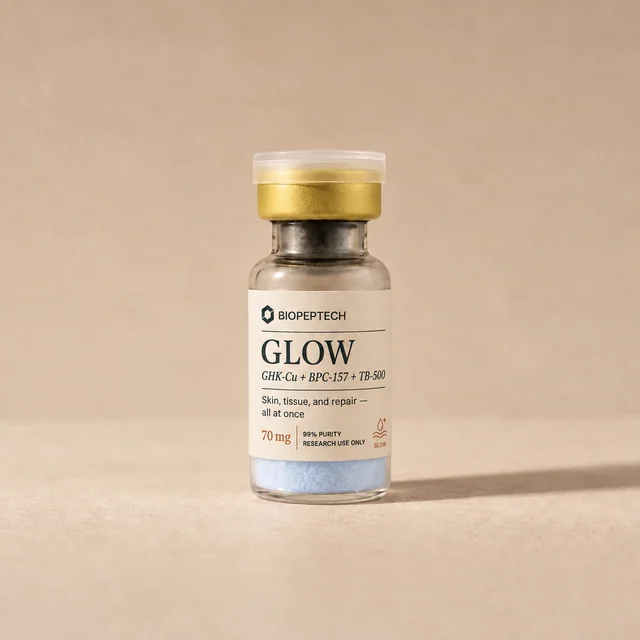
GLOW
GHK-Cu + BPC-157 + TB-500
Skin, tissue, and repair — all at once.
Full-panel lab testing Sampled vial
Certificate of Analysis
Independently tested by Analiza Białek across six test categories.
- GHK-Cu56.94 mg
- BPC-15710.04 mg
- TB-5009.50 mg
- 01Purity99% reported
- 02Molecular identityMolecular mass tested
- 03Measured contentGHK-Cu 56.94 mg, BPC-157 10.04 mg, TB-500 9.50 mg
- 04Endotoxins7.97 EU/vial measured
- 05Microbial screeningTAMC / TYMC pass; E. coli, Salmonella not detected
- 06Heavy metalsAs, Cd, Pb, Hg measured
Report noteThe report’s molecular-mass rows use the name BALIPEPS; its client, sample name and batch identify BIOPEPTECH GLOW. The original report is provided unchanged.
Complete results
Analiza Białek · Order 100019417 · Completed 4 November 2026
| Purity | 99% |
|---|---|
| Molecular identity | Molecular mass tested (see PDF) |
| GHK-Cu content | 56.94 mg |
| BPC-157 content | 10.04 mg |
| TB-500 content | 9.50 mg |
| Endotoxins (measured) | 7.97 EU/vial |
| TAMC | Pass |
|---|---|
| TYMC | Pass |
| E. coli | Not detected |
| Salmonella | Not detected |
| Arsenic | <0.010 mg/kg |
|---|---|
| Cadmium | 0.088 mg/kg |
| Lead | 0.301 mg/kg |
| Mercury | <0.010 mg/kg |
Bundle offer
Mix any 3+ products
Quantities count. Discount applies to every eligible item.
Bacteriostatic water is excluded and does not count toward the 3.
Also available as
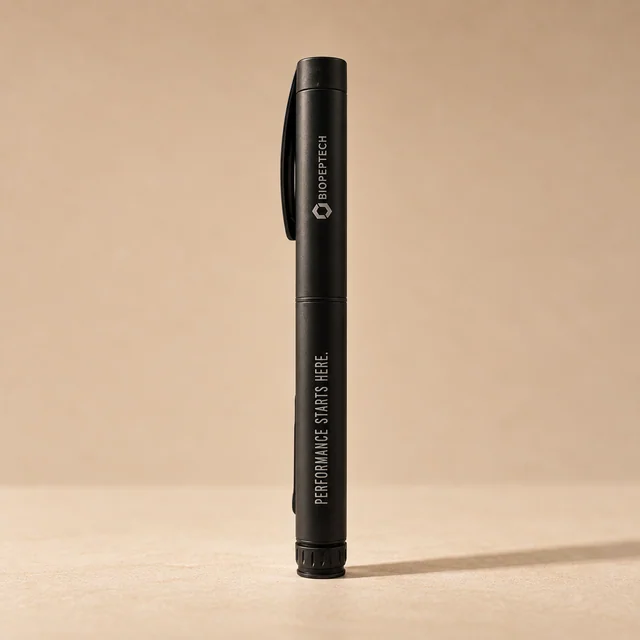 Pre-filled penGLOWGHK-Cu + BPC-157 + TB-500Rp 3.500.00050 mg + 10 mg + 10 mg
Order Inclusions
Peptides, precisely combined.
Skin and tissue, regenerated from within.
The body's master healer.
Recovery, accelerated.
What it does for you
- Speeds up how fast your skin and tissue repair themselves from the inside out
- Reduces the chronic inflammation that slows healing and dulls your complexion
- Boosts collagen and elastin, the two proteins that keep skin firm and elastic
- Delivers fresh blood and nutrients to skin cells for a visible, healthy glow
Research & evidence
What is known about GHK-Cu + BPC-157 + TB-500?
Research content updated
GHK-Cu
The copper(II) complex of the tripeptide glycyl-L-histidyl-L-lysine (GHK), studied in cell, skin-equivalent, and topical cosmetic research.[1][2][3]
Cell and skin-equivalent studies report matrix-remodeling and keratinocyte-related effects. One small topical cosmetic study evaluated a lipid-nanocarrier serum for facial wrinkle parameters; that is not evidence of clinical wound repair or a different formulation's effects.[1][2][3]
Evidence limits: Results depend on experimental model and formulation. The available cosmetic study does not establish wound-healing efficacy, safety across routes, or results for BioPepTech's exact batch or format.[1][2][3]
BPC-157
A synthetic pentadecapeptide discussed as a tissue-protective or repair peptide; proposed mechanisms and most repair-related findings are preclinical.[4][5]
As of November 21, 2026, one systematic review found only three small human studies (30 total participants) and rated the evidence very low certainty. No dedicated human tendon-repair study was identified.[4][5]
Evidence limits: Animal and mechanistic findings do not demonstrate human tendon healing. The small human reports are uncontrolled or pilot studies and do not establish general safety or effectiveness. Published findings do not test BioPepTech's exact batch or format.[4][5]
TB-500
A name used for a thymosin beta-4-derived fragment; it must be distinguished from full-length thymosin beta-4 (Tβ4), a separate 43-amino-acid peptide studied in some clinical research.[6][7]
A product-identification study detected an acetylated Tβ4 fragment in a TB-500 product sample. The located venous-ulcer clinical report described a trial of full-length Tβ4 and reported the trial was still ongoing at the time of publication; it does not establish TB-500 fragment efficacy.[6][7]
Evidence limits: TB-500 naming/composition may vary by product. No clinical outcome from full-length Tβ4 research should be attributed to TB-500 fragment products, and neither study tested BioPepTech's exact batch or format.[6][7]
Research is not a product certificate
These publications describe their authors' study materials, populations and methods. They do not certify a BioPepTech batch, device or formulation, establish a personal dose, or guarantee safety or results. Research products are not a substitute for medical care.
Common Questions
What is known about the ingredients in GHK-Cu + BPC-157 + TB-500?
The copper(II) complex of the tripeptide glycyl-L-histidyl-L-lysine (GHK), studied in cell, skin-equivalent, and topical cosmetic research. A synthetic pentadecapeptide discussed as a tissue-protective or repair peptide; proposed mechanisms and most repair-related findings are preclinical. A name used for a thymosin beta-4-derived fragment; it must be distinguished from full-length thymosin beta-4 (Tβ4), a separate 43-amino-acid peptide studied in some clinical research.[1][2][3][4][5][6][7]
What published evidence is relevant to GHK-Cu in this blend?
Cell and skin-equivalent studies report matrix-remodeling and keratinocyte-related effects. One small topical cosmetic study evaluated a lipid-nanocarrier serum for facial wrinkle parameters; that is not evidence of clinical wound repair or a different formulation's effects. Results depend on experimental model and formulation. The available cosmetic study does not establish wound-healing efficacy, safety across routes, or results for BioPepTech's exact batch or format.[1][2][3]
What published evidence is relevant to BPC-157 in this blend?
As of November 21, 2026, one systematic review found only three small human studies (30 total participants) and rated the evidence very low certainty. No dedicated human tendon-repair study was identified. Animal and mechanistic findings do not demonstrate human tendon healing. The small human reports are uncontrolled or pilot studies and do not establish general safety or effectiveness. Published findings do not test BioPepTech's exact batch or format.[4][5]
What published evidence is relevant to TB-500 in this blend?
A product-identification study detected an acetylated Tβ4 fragment in a TB-500 product sample. The located venous-ulcer clinical report described a trial of full-length Tβ4 and reported the trial was still ongoing at the time of publication; it does not establish TB-500 fragment efficacy. TB-500 naming/composition may vary by product. No clinical outcome from full-length Tβ4 research should be attributed to TB-500 fragment products, and neither study tested BioPepTech's exact batch or format.[6][7]
Do separate ingredient studies prove this combination works better?
No. The sources on this page concern individual compounds or related formulations, not a clinical validation of this exact blend. Combining ingredients does not establish synergy, compatible stability, safety or a superior clinical outcome.
Does the research establish results for this GHK-Cu + BPC-157 + TB-500 stack vial?
No. A paper about GHK-Cu + BPC-157 + TB-500 studies the material and conditions described by its authors, not this catalogue item. A research vial or blend must not be treated as equivalent to a licensed medicine or to a differently formulated study material.
What do the study references say about this GHK-Cu + BPC-157 + TB-500 batch?
Published studies do not certify a BioPepTech batch. Any laboratory report displayed on this page applies only to its identified sample, formulation and stated test scope. Check the batch and labelled amount against the document; purity alone does not establish sterility, clinical safety or effectiveness.
How should this GHK-Cu + BPC-157 + TB-500 stack vial be handled in Bali?
Follow the exact supplied label and batch-specific storage instructions for this stack vial; do not apply another product's expiry or a generic post-mixing deadline. Keep it protected from inappropriate heat and light, and ask BioPepTech about the applicable storage conditions if the package arrives warm, damaged or unclear. The catalogue amount is not an administration recommendation.
Study references & source notes
Evidence type matters: a laboratory experiment, an animal study and a human trial answer different questions. Older foundational studies are identified by their publication year; they are not presented as new trials.
1 · In-vitro fibroblast study and small topical cosmetic trial
Badenhorst T et al. (2016). Effects of GHK-Cu on MMP and TIMP Expression, Collagen and Elastin Production, and Facial Wrinkle Parameters Journal of Aging Science.
DOI: 10.4172/2329-8847.1000166
The study reports collagen and elastin production in cultured human dermal fibroblasts and a randomized split-face cosmetic study of a lipid-nanocarrier GHK-Cu serum in 40 women over eight weeks, with wrinkle-parameter changes.
Scope: The human component evaluated facial cosmetic wrinkle outcomes for a particular nanocarrier serum, not wound healing or a research-grade injectable product. The small study and journal quality warrant cautious interpretation.
Back to questions2 · In-vitro and skin-equivalent study
Kang YA et al. (2009). Copper–GHK increases integrin expression and p63 positivity by keratinocytes Archives of Dermatological Research.
DOI: 10.1007/s00403-009-0942-x
Cultured keratinocytes and skin-equivalent models showed increased proliferation-related markers and integrin expression with copper-GHK exposure.
Scope: Cell culture and skin-equivalent results are not evidence of clinical wound-healing benefit, efficacy, or safety in people.
Back to questions3 · Mechanistic and cosmetic literature review
Pickart L, Margolina A (2018). Regenerative and Protective Actions of the GHK-Cu Peptide in the Light of the New Gene Data International Journal of Molecular Sciences.
DOI: 10.3390/ijms19071987
The review discusses gene-expression, matrix-remodeling, animal and topical cosmetic findings involving GHK and GHK-Cu.
Scope: A review is not a new randomized trial. The authors list a Skin Biology research affiliation; mechanistic and topical findings cannot establish systemic efficacy or safety for a pen, vial or nasal spray.
Back to questions4 · Systematic review of human studies
Poolton JT et al. (2026). Human evidence for BPC-157 in orthopaedic and regenerative medicine: a systematic review of efficacy and safety Acta Orthopaedica Belgica.
DOI: 10.52628/92.3.15837
The review found three small human studies totaling 30 participants: retrospective reports involving knee pain (n=16) and interstitial cystitis (n=12), plus a two-person intravenous safety pilot. It rated the evidence very low certainty and found no dedicated human tendon-healing study.
Scope: Only three small studies were available; risk of bias, indirectness, and imprecision were serious. No dedicated tendon outcomes or evidence of efficacy for a particular research-product batch or format.
Back to questions5 · Retrospective uncontrolled pilot study
Lee E, Walker C, Ayadi B (2024). Effect of BPC-157 on Symptoms in Patients with Interstitial Cystitis: A Pilot Study Alternative Therapies in Health and Medicine.
A retrospective chart review described 12 women with interstitial cystitis who received one intravesical BPC-157 procedure; all reported improvement at follow-up. This was an uncontrolled symptom report, not a tendon or tissue-repair trial.
Scope: Very small sample, retrospective, no sham/control group, limited participant diversity, and no biopsies. No adverse events in this small sample cannot establish safety. The paper reported a compounded preparation, not BioPepTech's batch or format.
Back to questions6 · Analytical identification study
Esposito S et al. (2012). Synthesis and characterization of the N-terminal acetylated 17-23 fragment of thymosin beta 4 identified in TB-500, a product suspected to possess doping potential Drug Testing and Analysis.
DOI: 10.1002/dta.1402
Analytical characterization identified an N-terminal acetylated thymosin beta-4 17-23 fragment (Ac-LKKTETQ) in the TB-500 product analyzed. This supports distinguishing a TB-500 fragment from the full-length 43-amino-acid thymosin beta-4 used in clinical research.
Scope: This is an analytical product-identification study, not a clinical efficacy or safety trial. It does not prove all products sold under the TB-500 name have the same composition.
Back to questions7 · Clinical trial report/abstract for full-length thymosin beta-4
Guarnera G, De Rosa A, Camerini R (2007). Thymosin beta-4 and venous ulcers: clinical remarks on a European prospective, randomized study on safety, tolerability, and enhancement on healing Annals of the New York Academy of Sciences.
DOI: 10.1196/annals.1415.003
The report describes a planned double-blind, placebo-controlled, dose-escalation topical study of full-length thymosin beta-4 for venous ulcers, alongside debridement and compression. At publication, the trial was ongoing and 21 participants had been enrolled; the abstract does not provide efficacy results.
Scope: The source does not report completed trial outcomes and studies full-length thymosin beta-4 (Tβ4), not the TB-500 fragment. It cannot establish the efficacy or safety of TB-500.
Back to questions
GHK-Cu + BPC-157 + TB-500 in Bali
Select the listed format and amount, then use Add to cart or Buy now to review your order. Ask BioPepTech about current availability, product documentation and delivery to your complete address. Same-day delivery depends on confirmation and the daily 8pm Bali-time cutoff; it is not guaranteed for every address.