
Summary
What a real, verifiable Certificate of Analysis looks like, common red flags, and questions worth asking before you buy.
“Third-party tested” is not the same as verified
Nearly every peptide seller in Bali can say “third-party tested” and “same-day delivery.” Those phrases sound reassuring, but on their own they verify nothing. They do not tell you which laboratory performed the work, what sample was tested, when it was tested, which method was used, or whether the result belongs to the vial being offered today.
That does not mean every seller using those words is acting in bad faith. It means the words are marketing language until they are connected to evidence. A careful buyer should be able to move from a broad claim to a specific document, then from that document to an independently checkable fact. The real question is not whether a seller can display a polished badge or a confident sentence. It is whether the chain from product, to batch, to laboratory, to result remains intact.
The same principle applies to “same-day delivery.” Fast local delivery can be useful in Bali, especially for materials that need careful handling, but speed does not demonstrate identity, purity, storage history, or testing. A vial can arrive quickly and still be poorly documented. Conversely, a responsible supplier should be able to discuss both documentation and delivery conditions without treating either one as a substitute for the other.
What a real Certificate of Analysis should show
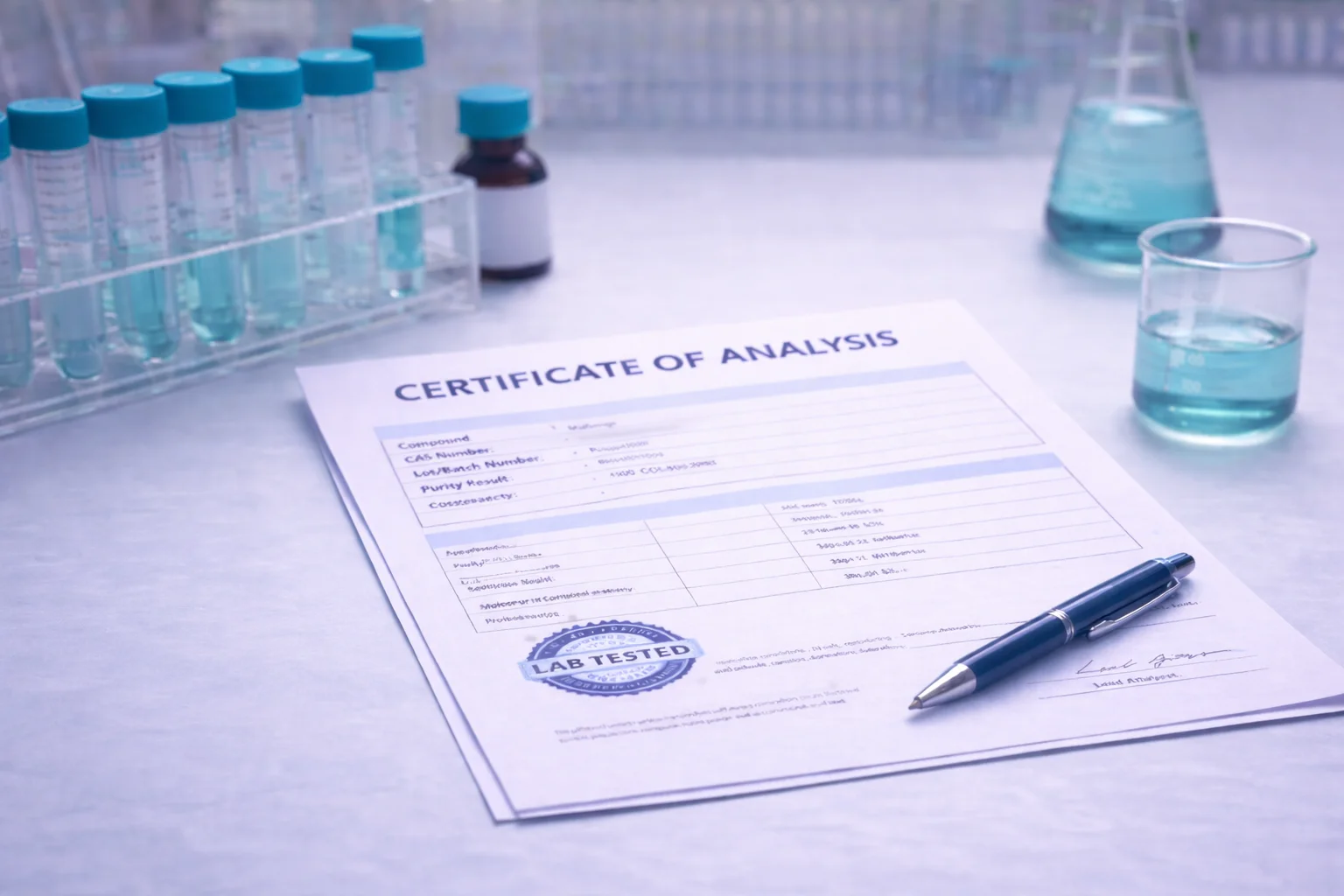
A Certificate of Analysis, usually called a CoA, is a quality document describing the results obtained from testing a defined sample. The format varies between laboratories, but a useful document should contain enough detail for you to understand what was tested and to connect the result to the material you received.
1. A batch or lot number that matches the vial
The most important link is traceability. The batch or lot number on the CoA should match the number on the vial, box, or order documentation. If the seller sends a certificate with a different lot number, ask why. There may be an innocent explanation—a document for a previous batch, a packaging change, or an administrative error—but the mismatch should be resolved before you treat the result as evidence for your material.
The document should also make clear what the batch represents. A batch number that appears only in a file name, while the body of the document contains no product or sample identification, is weaker than a certificate that names the compound and sample directly. Traceability is not about making a document look official. It is about connecting the tested sample to the product in your hands.
2. The actual testing laboratory
“Independent lab” or “third-party lab” is not a laboratory name. A meaningful CoA identifies the testing facility, ideally with an address, website, accreditation information, or another way to understand who performed the work. You should be able to search for the lab separately rather than relying only on a logo or email address printed on the certificate.
Independent testing also means the laboratory is separate from the seller in the relevant transaction. It does not automatically mean every result is perfect, and it does not mean every laboratory tests every compound equally well. It does give you a starting point for asking whether the facility has the equipment and competence to perform the stated analysis. ISO/IEC 17025 is one internationally recognised framework for the competence of testing and calibration laboratories, although a logo on a document should still be checked rather than accepted at face value.
3. The test method
For peptide purity, HPLC—high-performance liquid chromatography—is a commonly referenced analytical method. It separates components in a sample and allows an analyst to evaluate the proportion associated with the target compound. A CoA should identify the method clearly enough to understand what was actually measured. Depending on the laboratory and purpose, it may also include method conditions, a chromatogram, retention time, or a reference standard.
HPLC is valuable, but “HPLC tested” is not a complete quality story. The method has to be appropriate for the compound, performed on the relevant sample, and interpreted by a competent laboratory. A purity result also does not prove sterility, correct identity, correct concentration, or safe use. Those are different questions that require different methods and controls. A confident supplier should be comfortable explaining the limits of a test rather than presenting one number as proof of everything.
4. A specific result, not a mood
Look for a named compound and a specific reported purity percentage, such as a result expressed to a defined number of decimal places. “High purity,” “premium grade,” and “99% quality” without a test result are descriptions, not analytical findings. The number should appear alongside the sample identity, batch, method, and test date.
Read the result in context. A purity percentage may refer to an area percentage from a chromatographic method rather than a complete assessment of the vial's contents. It may not account for water, counterions, residual solvents, endotoxin, microbial contamination, or the accuracy of the stated mass. Good documentation makes the scope visible. It does not ask one test to answer questions it was never designed to answer.
5. An independently verifiable report ID
Some laboratories provide a report number, certificate ID, QR code, or online portal that allows the report to be checked. This is not mandatory in every legitimate laboratory workflow, but it is useful additional evidence. If a verification portal exists, access it through the laboratory's independently sourced website rather than clicking an unfamiliar link in a forwarded message.
Be alert to documents that contain a lab logo but no report number, date, analyst or authorisation details, sample description, or contact route. None of these omissions proves misconduct on its own. Together, however, they make the document difficult to verify and should lower your confidence until the seller can fill in the gaps.
Red flags worth taking seriously
Red flags are patterns, not courtroom verdicts. One missing detail can be an administrative mistake. Several missing details, combined with pressure to buy, deserve a pause.
- A generic stock CoA: The file is reused for every product, every date, or every batch. The lot number does not match the vial, or no lot number appears at all.
- A vague laboratory claim: The seller says “tested by a third party” but will not name the lab or explain what method was used.
- A single purity number presented as total proof: The document gives a percentage but no identity, batch, method, date, or scope.
- Overly polished testimonials: Testimonials that use identical language, make sweeping promises, or sound more like advertising copy than a person's experience should not replace documentation.
- Urgency without substance: Countdown timers, “last vial” messages, or pressure to send payment before answering basic quality questions are not evidence of quality.
- No real pre-purchase contact: If you cannot reach a person who can answer a straightforward question before purchase, support after purchase may be difficult as well.
- A dramatically low price: Low price is not proof of a bad product, but a large unexplained gap deserves questions about sourcing, documentation, packaging, and what exactly is included.
- Unclear sourcing: A supplier who cannot explain where material comes from, how batches are labelled, or which records accompany an order is asking you to rely on trust alone.
- Storage treated as an afterthought: In Bali, a responsible seller should be able to explain how heat, humidity, light, and delivery time are managed, especially for materials that require controlled handling. Our tropical storage guide covers the receiving and storage side in more detail.
None of these points requires naming or attacking a particular competitor. They are simple prompts to slow down and compare evidence with presentation.
Good questions to ask before you buy
The best questions are specific, calm, and easy for a legitimate supplier to answer:
- Can I see the CoA for the specific batch I will receive? Ask for the lot number and compare it with the vial or order confirmation.
- What lab performed the testing, and can I verify it independently? Search for the laboratory yourself and ask whether it offers report verification.
- What method was used for the stated purity result? For peptide purity, ask whether HPLC was used and what the result actually measures.
- Does the report identify the sample, date, analyst, and report number? These details make a document more traceable.
- How is cold-chain or temperature control maintained during Bali delivery? Ask what happens from dispatch through handoff, not just whether delivery is fast.
- What is your policy if a product arrives compromised? A clear process for damaged packaging, temperature concerns, or a mismatched batch is more useful than a blanket promise that every order is perfect.
- What records accompany the batch? A responsible supplier should be able to explain how the vial, label, CoA, and order are connected.
You can also ask what a test does not establish. This is often revealing. A supplier who understands testing should be able to say that an HPLC purity result is not the same as sterility testing, identity confirmation, or a guarantee about handling after delivery. For a deeper explanation of how to read the document itself, see our Certificate of Analysis guide, and review BioPepTech's quality assurance standards.
A simple decision process
Start with documentation before discussing price. Ask for the specific batch CoA, read the result, and note every identifier. Next, verify the laboratory independently and check whether the method matches the claim being made. Then ask about packaging, temperature handling, delivery, and what happens if something goes wrong.
If the answers are clear, consistent, and proportionate, you have better information for an independent decision. If the seller avoids direct answers, changes the subject to testimonials, or increases pressure when you ask for evidence, pause. You do not need to prove that a supplier is dishonest in order to decide that the available information is not strong enough.
This approach also keeps expectations realistic. A CoA is evidence about a tested sample and a defined set of measurements. It is not a guarantee that a vial was stored correctly after testing, and it is not a substitute for professional advice, regulatory review, or independent judgment. Quality is a chain: identity, batch traceability, analytical testing, packaging, storage, delivery, and clear communication all matter.
The most trustworthy buying experience is rarely the loudest one. It is the one where a supplier can show what was tested, who tested it, which batch it came from, what the result means, and what the limits are. In Bali's fast-moving local market, those details are more meaningful than a slogan about speed or a badge that cannot be checked.
Safety & Regulatory Note
This guide is educational and does not constitute a recommendation of any specific supplier. Always exercise independent judgment.
References
- 1.International Organization for Standardization. (2017). ISO/IEC 17025:2017 — General requirements for the competence of testing and calibration laboratories. https://www.iso.org/standard/66912.html
- 2.U.S. Food and Drug Administration. (2015). Analytical Procedures and Methods Validation for Drugs and Biologics: Guidance for Industry. https://www.fda.gov/media/87801/download
- 3.Manning MC, Chou DK, Murphy BM, Payne RW, Kat AA. (2010). Stability of protein pharmaceuticals: An update. Pharmaceutical Research, 27(4), 544–575. https://doi.org/10.1007/s11095-009-0025-3
